
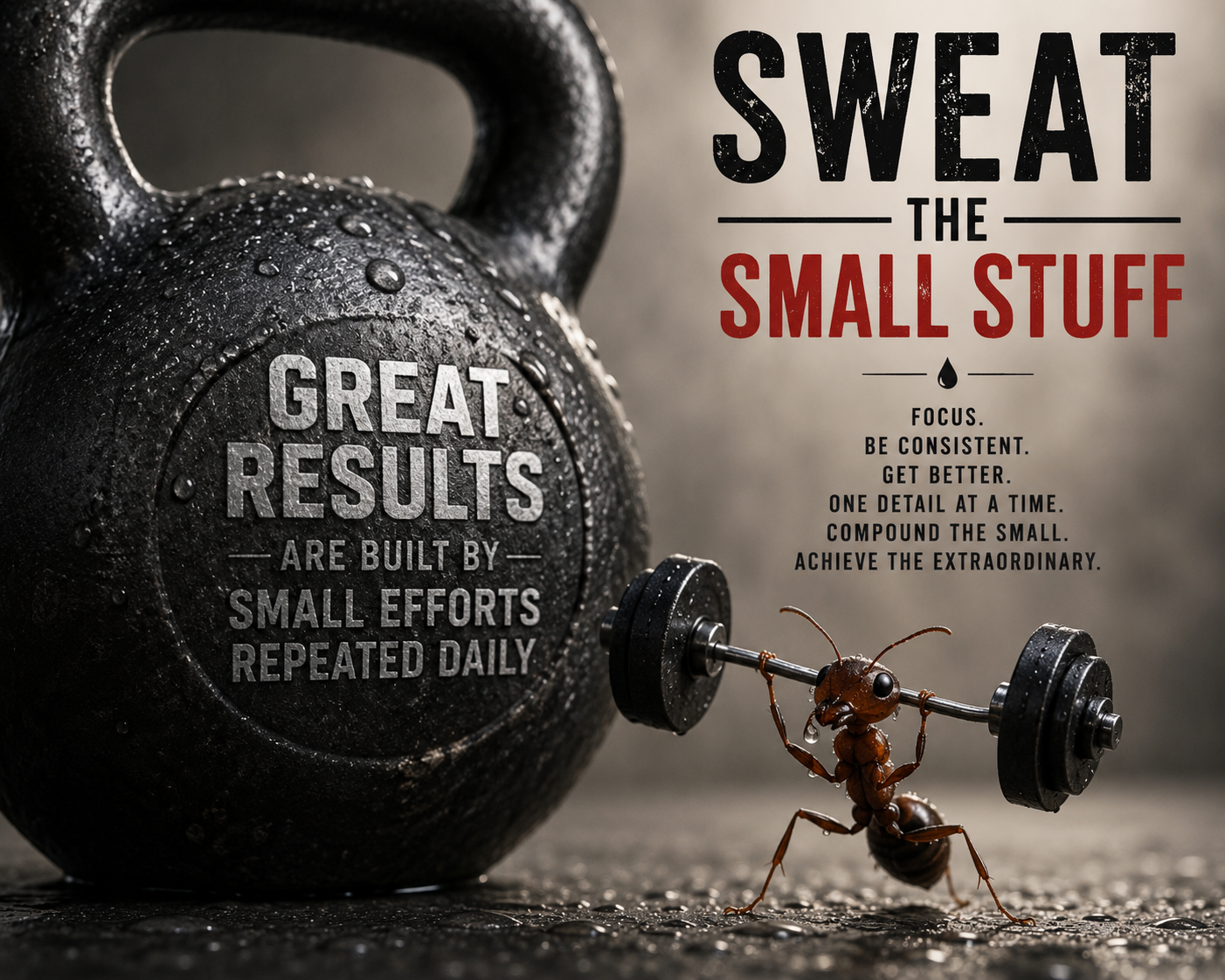
Sweat the Small Stuff
Big changes often begin with small actions. Nearly thirty years of martial arts teaching have shown me how respect, discipline, failure and perseverance accumulate into something much larger.
BERKELEY HEIGHTS, NJ: In 1997, I was completing my first year of teaching martial arts while also holding down a sales job.
Around the same time, Richard Carlson's book Don't Sweat the Small Stuff came out.
Given the level of detail I was putting into my martial arts practice, while simultaneously learning how to teach four-to-six-year-old kids, I remember thinking that if I ever wrote a book, I'd call it the opposite:
Sweat the Small Stuff!
Seventeen years later, in 2014, I came across the commencement speech given by Admiral William H. McRaven at the University of Texas at Austin.
Needless to say, the speech resonated with me.
It became widely known as the “make your bed” speech, built around lessons McRaven had learned through Navy SEAL training. One of his central ideas was remarkably simple: if you want to accomplish the big things, learn to do the little things well first.
Oddly enough, four months after that speech was given, I stopped working for someone else and put a large chunk of my life's savings into opening White Tiger Dojo.
Although the plan had begun almost a year earlier, it took just under twelve months to get all of the details lined up.
Twelve years later, I found myself thinking about that speech again, along with the idea I'd had for a book nearly thirty years earlier.
It made me realize just how many positive lessons I've learned through studying conflict.
And how often the big lessons begin with very small things.
Start With a Salutation: Small Habits Build Discipline
When you come into the dojo, we start and end each class with a bow.
It isn't always perfect, but it's one of those little things that closes one space and opens another.
When you start a kata (form), bunkai (applications), or jiu-kumite (sparring), you bow.
I sometimes think of it like closing one application on a computer to free up memory for another.
It's an energy-management moment.
It's also a shared moment of respect when working with a partner.
Something small tells the mind:
That is finished. Now we begin this.
A Good Partner Is a Good Student: Learning Cooperation and Awareness
A good student is also a good partner.
Whether it's in relationships, business or on the mat, being attentive to the small details is a shared duty.
Life is complicated and full of small and large conflicts.
Having a partner share the burden of those details, with overlapping fields of awareness, memory, care and respect, is one of life's great lessons about interacting with people.
Sometimes another person sees what you don't.
Sometimes you see what they don't.
That's part of what makes a good partnership work.
Respect Everyone: Martial Arts, Integrity and Leadership
No matter where you are or what you're doing, start by showing respect.
How you treat someone who can do absolutely nothing for you says a great deal about your integrity.
It's also why I can never tell you “who will become a black belt.”
Anyone who tells you they can is either a fool or thinks you are.
I've watched too many students surprise me.
It's also why I don't make a big deal about the word “sensei.”
I don't use it to command respect. It's a technical term commonly understood as teacher, and literally carries the idea of “one who came before.”
I've simply been on this martial journey longer than most of my students.
What's wonderful about that is I've been able to help students develop skills far beyond where mine were when I held their rank.
Some of the blue belts I've promoted today are almost as good as the black belt I was in 2000.
That's progress.
And I'm proud of it.
Life Isn't Fair: Teach Children to Fail Forward
No matter how well you prepare, you can still fail.
Keep moving forward.
Life isn't always fair, and you're going to fail more than once, so learn how to fail forward.
Observe your failures and successes as much like a scientist as you can.
What happened?
What worked?
What didn't?
What can you change?
Emotion is part of being human, so I'm not suggesting that we eliminate it.
But if we can create enough distance to actually learn from what happened, failure becomes information we can use.
That's how we become better versions of ourselves.
Chaos Is Inevitable: Discipline Helps Us Handle Adversity
No matter how disciplined you are, life will throw you curveballs.
Perhaps one of the toughest things to do is maintain discipline when it feels like all of your discipline failed to prevent something life-changing from happening.
But discipline isn't a promise that nothing bad will happen.
It's part of what helps us decide what to do after it does.
That's an important distinction.
Dive Head First: Confidence Begins With Starting
One of the most difficult parts of changing your life for the better is simply starting.
Starting martial arts means walking through a door without knowing exactly what waits on the other side.
You won't know all the movements.
You won't understand all the terminology.
You probably won't be particularly good at it.
Good.
Start anyway.
Every class, every technique, every stripe and every colored belt moves you farther from the person who first walked through the door.
Keep going.
And when things become difficult...
Stand Your Ground: Awareness and Verbal Self-Defense
Awareness matters.
How we move through the world can communicate confidence, distraction, uncertainty or purpose.
That doesn't mean body language determines who becomes a victim, and responsibility for violence always belongs to the person committing it.
But I still want my students standing upright.
Eyes looking ahead.
Aware of what's around them.
Moving with purpose.
And possessing enough verbal confidence to establish a boundary or talk their way out of a problem when possible.
People who understand physical conflict should also understand the value of avoiding it.
De-escalate when you can.
Leave when you can.
Ask for help when you need it.
And understand that physical self-defense exists for those circumstances when safer options are no longer available.
We win all of the fights we avoid.
Without Darkness, There Is No Light: Struggle Builds Resilience
Without struggle, there is very little reason to change.
Life is full of curiosity that can lead to competence, confidence and eventually consistency.
But every step contains frustration points.
Failure.
Setbacks.
Doubt.
Those things aren't necessarily evidence that we're traveling in the wrong direction.
Sometimes they're simply evidence that we're traveling.
The harder something becomes, the calmer we need to become.
It's not easy.
But most things worth becoming good at aren't.
Don't Be a Stick in the Mud: Perspective Builds Perseverance
When you're stuck, hopefully you've practiced enough of the lessons above that you don't spend the rest of your time wallowing in the mud instead of singing in the rain with your buddy.
A friend's father used to say:
“I'm not complaining, I'm just explaining.”
It's hilariously accurate for some people and hilariously contradictory and dodgy for others.
One of the best ways I've found to keep my spirits up during difficult times is to remember how far I've already come, how many trials I've already passed and how many great people I've met along the way.
Perspective matters.
Sometimes looking backward is exactly what reminds you to keep moving forward.
It's Easy to Earn a Black Belt: Just Don't Quit
Don't quit.
That's obviously an oversimplification.
But there's also something wonderfully true about it.
Quitting often happens when expectations don't meet reality.
Progress takes longer than expected.
Training gets harder.
Life interferes.
Motivation disappears.
The black belt that once seemed exciting suddenly seems very far away.
So stop staring at the black belt.
Come to class.
Practice today's technique.
Fix today's mistake.
Take today's small step.
Then do it again.
And again.
That's how an enormous goal eventually becomes a collection of very small accomplishments.
The Final Chapter: Small Actions Create Meaningful Change
At the end of your days, you probably want to be remembered as someone who pushed through.
Someone who took worthwhile risks.
Someone who faced their fears.
Someone who stood up for themselves and others.
Someone who helped when they could.
Someone who failed, learned and continued.
Someone who didn't give up simply because things became difficult.
Nearly thirty years after joking that I'd write a book called *Sweat the Small Stuff*, I think I understand that idea a little better.
The small stuff isn't small because it doesn't matter.
It's small because that's usually where the big stuff begins.
A bow.
A detail.
A failure.
A conversation.
A class.
A decision to show up again tomorrow.
Sweat enough of those small things over a lifetime and, eventually, you may discover that you've changed your world and the world around you for the better.