
Love: What Makes White Tiger Dojo So Different?
Martial arts may teach students how to handle conflict, but meaningful training also requires trust, empathy and cooperation. That's where some of the strongest relationships in the dojo begin.
BERKELEY HEIGHTS, NJ: When I was in college, my psychology professor began our very first Psych 101 class by telling us there was no definition for love in our textbook.
I don't remember whether he ever explained why.
If I were to guess today, I'd say it's because some of the most important parts of being human are also among the most difficult to neatly quantify.
We can certainly define love. We can study it. We can describe attachment, affection, relationships and human behavior.
But experiencing love is something different.
For me, love begins with something fairly simple:
People want to be known, accepted and loved.
Knowing Others Begins With Knowing Yourself
In order to be known, it helps to know yourself first.
That's one of the first things we tackle at White Tiger Dojo.
Self-knowledge can lead to greater self-control, and self-control can help create a life with more harmony and less unnecessary conflict.
Coincidentally, it can also make us a little easier to live with.
And perhaps easier to love.
We Don't Talk About Love Much in the Dojo
Love isn't a word we use very often during martial arts classes.
But we express it all the time.
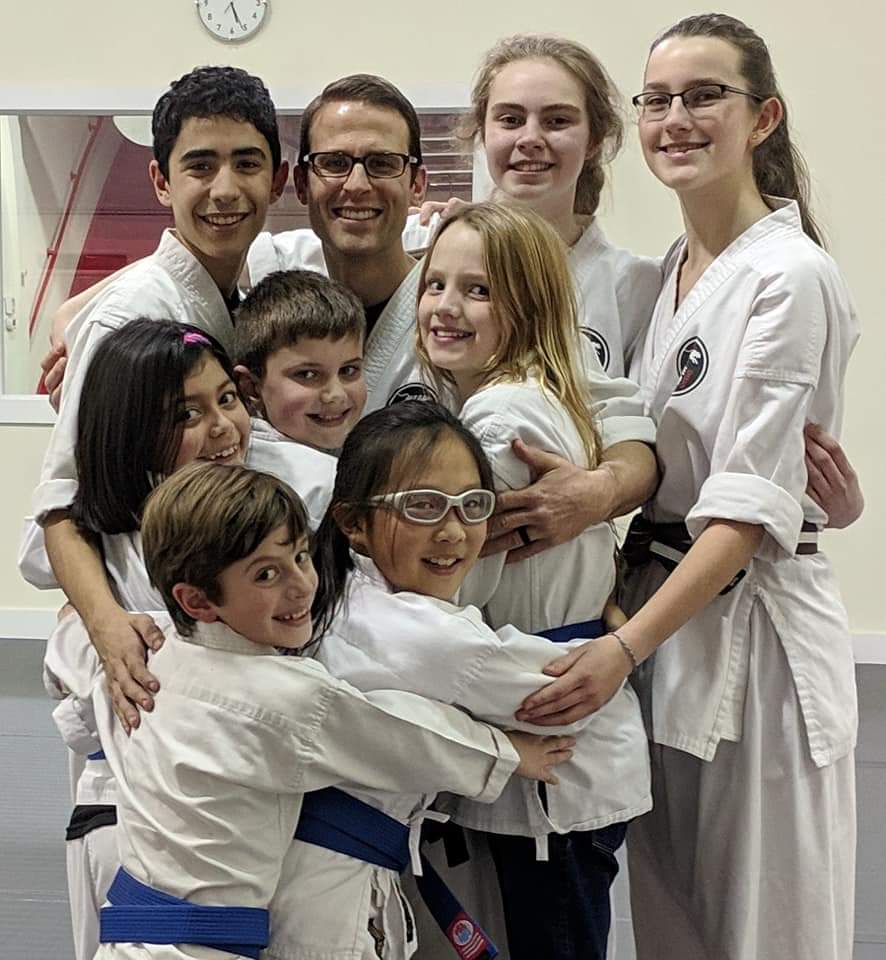
Anyone stepping onto the mat who is comfortable with hugs will naturally gravitate toward me, the assistants or each other for that simple acknowledgment that they're “home” with their martial kin.
It happens before class.
It happens after class.
And occasionally, one hug somehow turns into a ridiculous pile of students and instructors embracing each other at once.
But affection isn't the only way we express it.
We also express our care for one another by training hard together.
We challenge each other.
We cooperate.
We allow our partners to make mistakes.
We help them improve.
And together, we work through the problems created by physical and verbal conflict.
Learning Self-Defense Requires Trust
One of the exercises we use is called “See, Say, Do: Ask, Tell, Yell.”
Two students who like and respect each other temporarily take on very different roles.
One may become the con artist, sneak or wrongdoer.
The other has to recognize what's happening and practice protecting themselves visually, verbally and, when appropriate, physically.
Then they switch.
The person who was protecting becomes the problem.
The person who was creating the problem now has to solve it.
Think about what that requires.
You have to trust your partner enough to let them challenge you.
You have to care enough about your partner to challenge them responsibly.
And then you have to switch perspectives.
That's an unusual kind of cooperation.
Conflict and Empathy Can Exist Together
Students gradually discover that understanding conflict doesn't require abandoning empathy.
In fact, understanding another person's perspective can sometimes make us better at recognizing, avoiding and resolving conflict.
A good training partner learns both sides.
How does pressure feel?
How does intimidation work?
What does someone's body language communicate?
What happens when a boundary is ignored?
What happens when someone confidently establishes one?
Our students get an opportunity to experience these questions from more than one perspective.
Typically, the exercise ends with a bow.
And quite often, a hug.
The conflict was practiced.
The relationship remains.
Martial Arts Can Teach Us About Ourselves
At the end of the day, we learn about ourselves through the educational lens of conflict.
Sometimes literally.
We see ourselves in the long, tall mirrors lining the dojo walls.
But we also see ourselves reflected through our training partners.
They expose our strengths.
They reveal our weaknesses.
They frustrate us.
They encourage us.
They trust us enough to challenge us, and we trust them enough to return the favor.
Over time, that builds respect, knowledge, friendship and a bond that can be difficult to explain to someone who has never shared the mat with you.
Maybe my psychology professor was right to begin his class without a definition.
I'm still not sure I can perfectly define love.
But after all these years on the mat, I know what it looks like.