
The Gift of Failure
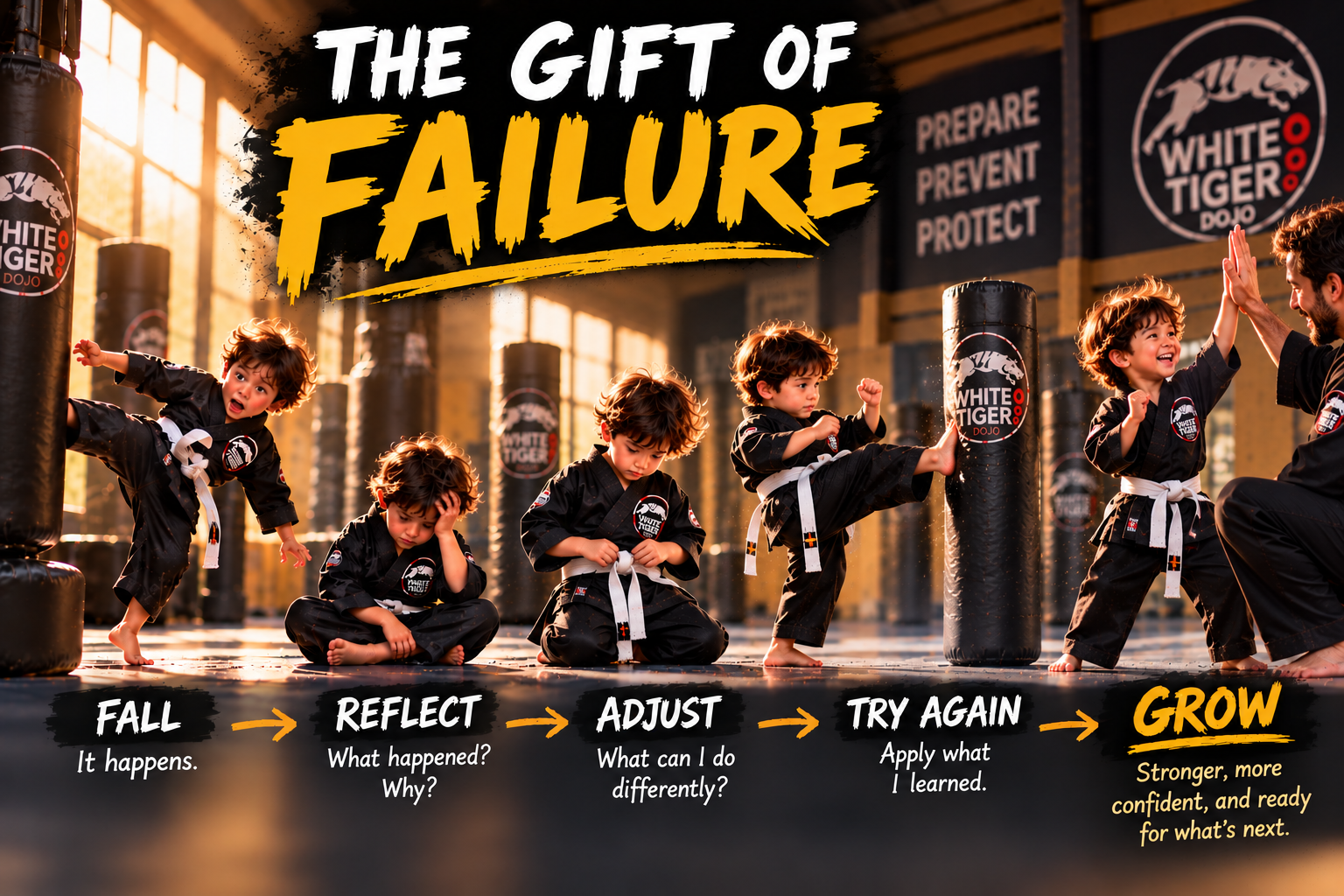
Failure doesn't have to undermine a child's confidence. When children experience manageable setbacks and learn what to do next, mistakes can become feedback that builds resilience, responsibility and self-discipline.
BERKELEY HEIGHTS, NJ: Recently, a friend of mine posted an article about kids and their homework.
In it, the author expressed her consternation about being required to "sign off" on her second grader's homework.
What exactly was the parent's responsibility?
Was she supposed to make sure every answer was correct?
Teach material her child didn't yet understand?
Or simply acknowledge that she had seen the work?
Those are interesting questions.
But I think there's a larger one hiding underneath them:
When should parents and teachers allow children to experience failure?
I don't think that's a question reserved for children.
It's relevant to anyone who finds themselves in a position to help or hinder another person's growth.
In other words, just about everyone.
Children Need Opportunities to Experience Failure
I remember when some of my four-to-six-year-old students were preparing for a test and a concerned mother asked:
"What if David doesn't pass?"
I replied:
"He'll learn to try harder next time. Besides, he's only five years old. If he doesn't fail now, when is a more appropriate time?"
An interesting conversation followed about when it's appropriate to fail and how the gift of failure can help develop pride, responsibility and discipline.
Failure at five doesn't need to be catastrophic.
In fact, that's partly the point.
When the stakes are relatively small and trusted adults are nearby, children have an opportunity to discover something extremely important:
I can fail at something and still be okay.
Then they can figure out what to do next.
Let Children Make Mistakes While the Stakes Are Small
There's an old tongue-in-cheek saying about elections:
"Vote early and often."
If you could vote early and often, presumably you'd improve your chances of getting the result you wanted.
Perhaps children should be allowed to fail early and often for much the same reason.
The earlier children encounter manageable mistakes and setbacks, the more opportunities parents and teachers have to help them understand what happened.
What went wrong?
What could you do differently?
Did you prepare enough?
Do you need more practice?
Do you need help?
Should you try another approach?
The objective isn't failure for failure's sake.
The objective is learning how to respond when failure inevitably arrives.
A Growth Mindset Doesn't Mean Pretending Failure Doesn't Hurt
This is where the idea of a growth mindset becomes useful.
A growth mindset isn't simply telling a child, "You can do anything!"
And it certainly doesn't mean every attempt will eventually produce the result we want.
It means recognizing that where we begin doesn't necessarily determine where we finish.
Ability can develop.
Skills can improve.
Strategies can change.
We can ask for feedback.
We can practice.
We can try again.
Natural ability may give someone a head start, but a starting point isn't necessarily an endpoint.
That's why failure can be valuable.
It gives us information about what needs to happen next.
Failure Is an Event, Not an Identity
In a highly competitive world, we tend to view failure as something that slows people down or undermines confidence.
But perhaps the bigger problem isn't failure itself.
It's what we teach children that failure means.
There's an enormous difference between:
"I failed at this."
and:
"I am a failure."
One describes an event.
The other describes a person.
Children, and adults for that matter, need to learn to let individual events stand on their own merit instead of turning them into sweeping conclusions about themselves.
I missed the kick.
I forgot part of the kata.
I didn't pass the test.
I lost the match.
I got the answer wrong.
Those are things that happened.
Now we can examine them.
That's where self-critique becomes useful rather than destructive.
What happened, why did it happen, and what can I do about it?
That kind of honest self-evaluation can become an important form of self-discovery and self-discipline.
Protecting Children From Every Mistake Can Remove Useful Feedback
Imagine a child learning something that requires balance.
The child starts to wobble.
Do we immediately grab them every single time?
Do we allow them to attempt the challenge in a reasonably safe environment?
Do we change the difficulty of the challenge when it's clearly beyond what they're ready to handle?
There isn't one correct answer for every child or every situation.
That's where parenting and teaching require judgment.
But if we prevent every wobble, every mistake and every disappointment, the child loses some of the feedback that comes from experiencing the problem.
Sometimes the wobble teaches balance.
Sometimes getting an answer wrong exposes what we don't understand.
Sometimes losing tells us what we need to practice.
Sometimes frustration tells us we need another strategy.
Failure is information.
Our job isn't necessarily to eliminate that information.
It's to help children learn how to use it.
Children Need Success Too
Of course, there's another side to this.
Constant failure isn't automatically character building.
Give someone a challenge far beyond their current ability and repeated failure may teach very little except frustration.
Some people respond to setbacks by becoming more determined.
Others become discouraged.
And the same person may respond differently depending upon the situation.
That's why parents and teachers have to help calibrate the scales.
Too little challenge and there's nothing to overcome.
Too much challenge and there may be no realistic path forward.
Somewhere between those extremes is a productive struggle where a child can fail, adjust, improve and eventually succeed.
And success matters too.
Success gives children evidence that their effort, strategy and perseverance can actually change an outcome.
The lesson isn't:
"Failure is good."
The lesson is:
"Failure can be useful."
Don't Take Away the Gift of Failure
No matter how much we tell children about our own failures, eventually they're going to have to experience theirs.
We can't hand them resilience.
We can't explain perseverance so thoroughly that they'll never have to practice it.
And we can't build confidence for them by making sure they always succeed.
They have to participate.
They have to try.
Sometimes they have to struggle.
Sometimes they have to fail.
Then they have to decide what happens next.
That's the gift.
Because when children learn that failure is something they can examine, learn from and move beyond, it stops being something they have to fear.
Failure becomes feedback.
And when failure and success are allowed to work together, children begin discovering something far more valuable than how to avoid mistakes.
They discover that a mistake doesn't have to be the end of the story.