
The Perception Puzzle
We don't simply see the world as it is. Our experiences, assumptions and perspectives influence what we notice. Martial arts can teach students to challenge those perceptions and make better decisions.
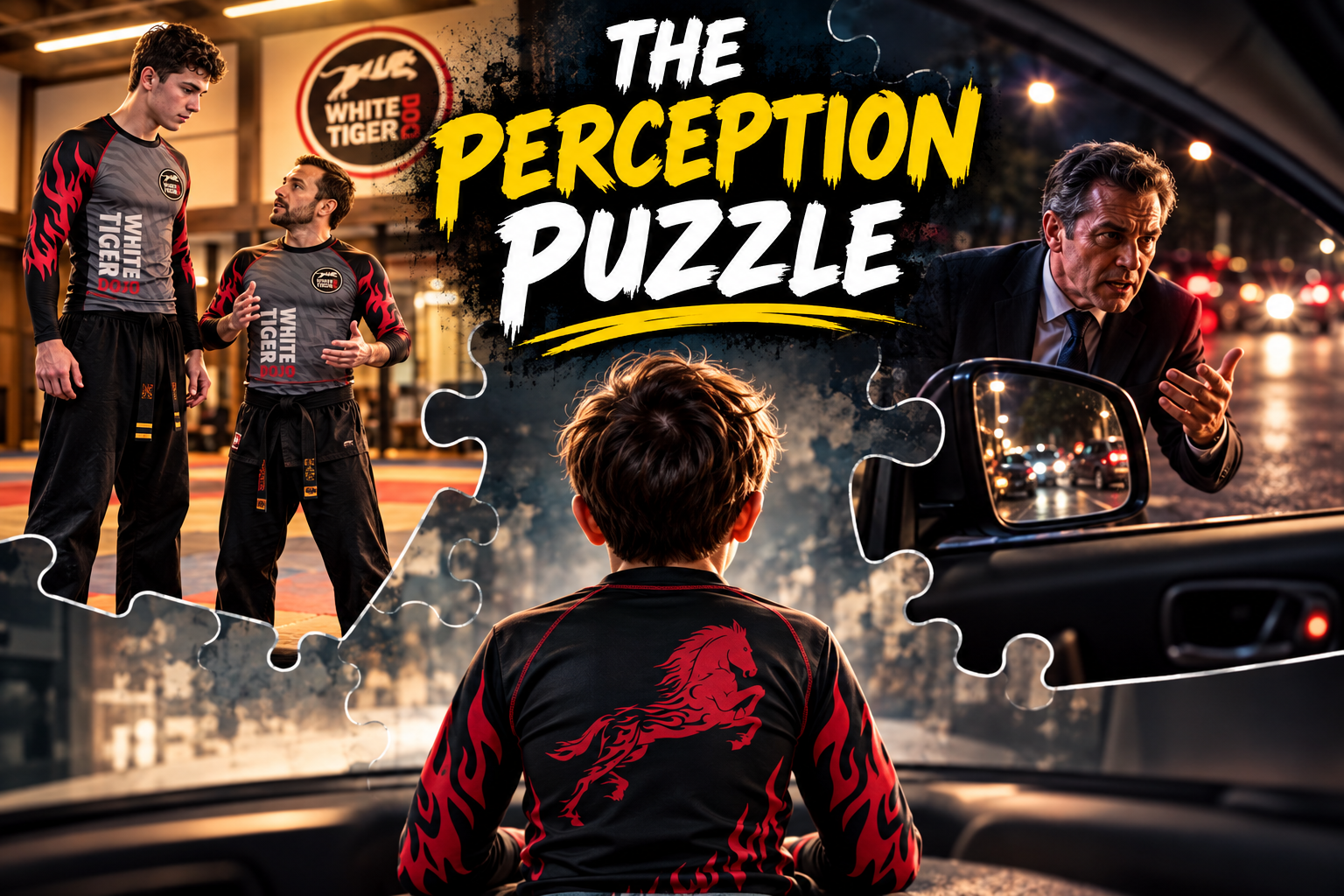
BERKELEY HEIGHTS, NJ: They say perception is everything, but what makes up our perceptions?
Experiences, ideas, surroundings, family, friends, coworkers, height, weight, intelligence and countless other factors all contribute to how we perceive the world.
Some of what we perceive we're consciously aware of, like a fly darting toward our eye.
Other information gets processed so quickly that we barely recognize we're processing it at all.
Either way, our perceptions influence how we understand the world around us.
But there's another side to that relationship:
Our perceptions shape who we are, and who we are shapes our perceptions.
Our Experiences Change How We See the World
I have a student who stands six feet six inches tall.
I'm five feet six.
Needless to say, our "perceptions" are quite obviously different.
He wants to find a better way to take my head off, and I want to find a better way to "chop him down to size."
He looks at the world from the top down.
I look at it from the bottom up.
We can stand in exactly the same place, encounter exactly the same problem and see two very different things.
That's important.
Because sometimes what looks obvious from where we're standing looks completely different from somewhere else.
Martial Arts Teaches Students to Adapt Their Perception
In martial arts, when we practice self-defense movements with a partner, we have to adapt to the person standing in front of us.
People aren't built the same.
Height changes things.
Reach changes things.
Strength changes things.
Speed changes things.
Mobility changes things.
Temperament changes things.
Working with someone who has a similar body type and mindset may be easier.
But real conflict rarely comes customized.
That's why working with different partners is so valuable.
The technique may remain recognizable, but distance changes.
Timing changes.
Targets change.
Angles change.
What worked beautifully against one person may require adjustment against another.
The more varied the people we train with, the more opportunities we have to challenge our assumptions.
Seeing a Situation From Another Perspective Gives Us More Options
This principle extends far beyond martial arts.
Understanding a situation from multiple angles gives us more options in life.
Whether a conflict involves a coworker, family member, friend or stranger, being able to consider another person's point of view can sometimes help prevent the conflict from escalating.
That doesn't mean the other person is right.
It doesn't mean we have to agree with them.
And it certainly doesn't mean ignoring dangerous behavior.
It simply means asking:
What might be happening here besides the explanation that immediately occurred to me?
Sometimes that question creates another option.
A Red Light Taught Me Something About Perception and Conflict
Many years ago, I was coming to a stop at a red light on my way to see a movie with a friend.
Apparently, a man behind me wasn't happy with my speed.
He crossed the double line, cut in front of me, stopped his Mercedes and got out just as I came to a stop.
He walked toward my driver's side window.
He was clearly angry.
I had a decision to make.
I could respond to his anger with anger of my own.
Or I could try to understand what was actually happening.
I rolled down my window and said:
"Sir, would you like me to get out of the car and have an altercation with you at a red light at 9 PM on a Saturday night?"
He didn't say a word.
He turned around, walked back to his car and drove away when the light turned green.
I never even unbuckled my seatbelt.
Good Self-Defense Requires Seeing What Is Actually Happening
I couldn't have articulated everything going through my mind in real time.
Looking back, though, I can recognize some of what I was processing.
He was angry.
He had approached my car.
But he had not yet physically attacked me.
There were still options available that didn't require me to get out of the car and turn an argument into a fight.
Most importantly, I didn't have to accept the situation exactly as he presented it to me.
He appeared to be offering me a confrontation.
I didn't have to take it.
Instead, I gave him a question.
And apparently that question gave him a moment to reconsider what was about to happen.
Could I have interpreted the situation incorrectly?
Absolutely.
That's important too.
Perception isn't certainty.
Intuition Can Help Us, but It Can Also Be Wrong
When we perceive a situation, we're using more than the traditional five senses.
We're comparing what's happening now with things we've experienced before.
Our brains recognize patterns.
Sometimes that happens so quickly that we call the result intuition.
Experience can make that intuition incredibly useful.
A student who's trained for years may notice distance, posture, movement or tension that a beginner doesn't recognize yet.
A parent may hear something unusual in their child's voice.
A teacher may notice that a student's behavior is slightly different from normal.
But intuition isn't magic.
It can also be influenced by fear, assumptions, previous experiences and bias.
That's why awareness shouldn't simply mean:
Trust your first impression.
Sometimes awareness means:
Notice your first impression, then keep observing.
Clear Perception Creates More Choices
That's one of the reasons I value a clear head during conflict.
If fear, anger or ego decides what we're seeing before we've actually understood the situation, our choices can become very limited.
"He disrespected me."
"She's attacking me."
"He's trying to embarrass me."
"I have to respond."
Maybe.
But maybe there's something else happening.
The clearer our perception becomes, the more possibilities we may notice.
Walk away.
Ask a question.
Set a boundary.
Create distance.
Get help.
De-escalate.
Protect ourselves if necessary.
The more accurately we understand the problem, the better chance we have of choosing an appropriate response.
Self-Awareness Helps Us Understand Other People
One of the most powerful early lessons in martial arts is learning about the targets on our own bodies.
We use ourselves as a reference.
Where am I vulnerable?
What needs protecting?
How does distance change that?
What happens when I move?
What happens when my partner moves?
Understanding our own vulnerabilities can help us better understand another person's.
The same idea applies beyond the physical.
Understanding our own fears, habits, assumptions and reactions can make it easier to recognize that other people have theirs too.
And perhaps that's where perception becomes something more than simply noticing what's around us.
Awareness begins with seeing.
Self-awareness begins with recognizing how the person doing the seeing changes what is seen.
The clearer we become about both, the more choices we have about what to do next.