
Through The Looking Glass
What do children do when they think their parents aren't watching? Through the one-way mirror at White Tiger Dojo, parents can watch their kids struggle, problem-solve and gradually develop confidence, self-control and independence.
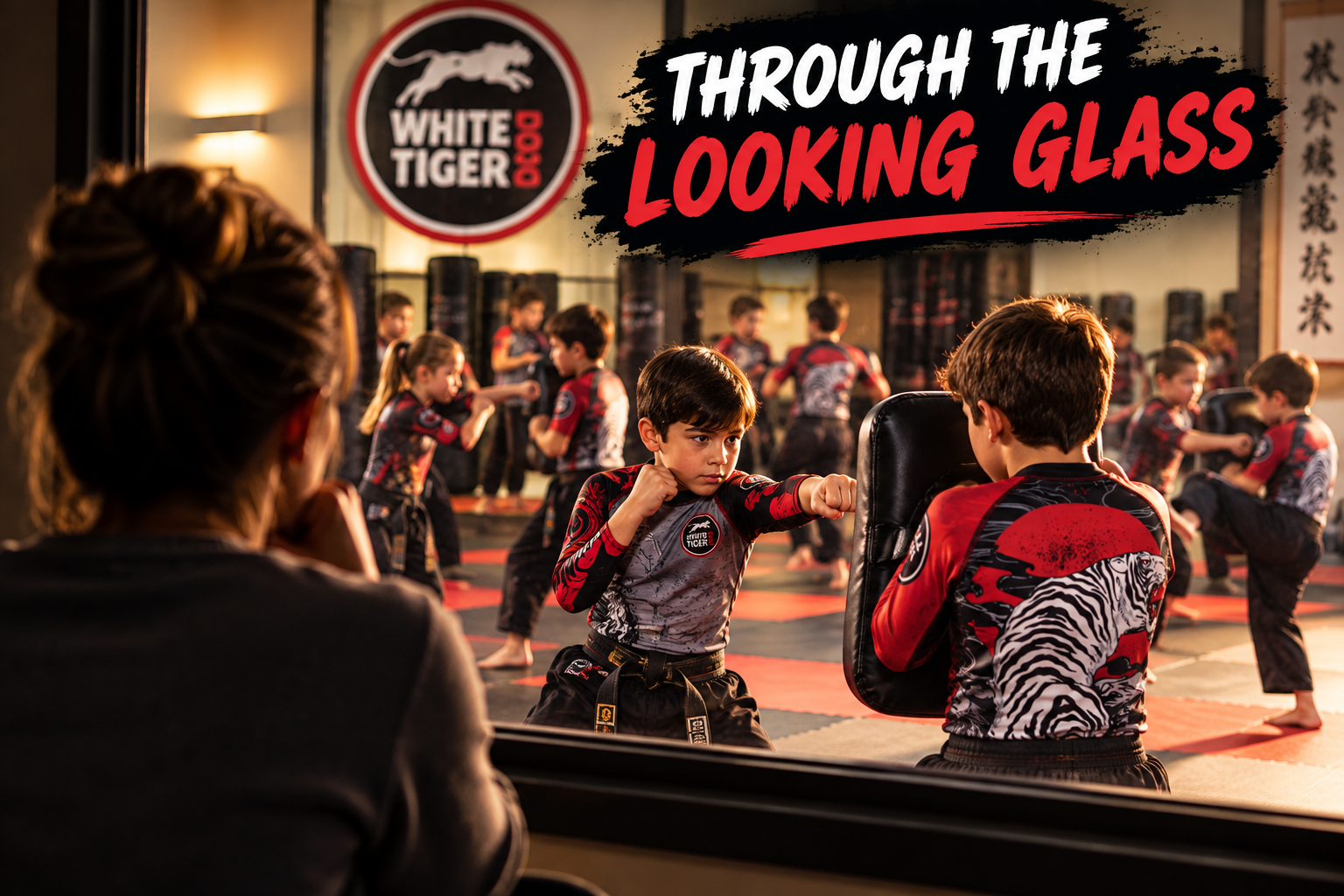
BERKELEY HEIGHTS, NJ: When I'm teaching kids, my active focus is on teaching them how to develop self-control through the art of self-protection.
My passive focus is on providing parents with an opportunity they don't often get:
The chance to watch their child interact, struggle, learn and problem-solve in a group environment without being directly involved.
At White Tiger Dojo, parents can watch class through a one-way mirror.
It's not often that parents get to observe their children from behind the scenes.
What Happens When Children Think Their Parents Aren't Watching?
The children may know you're in the other room, but they quickly become engrossed in their new environment.
There's a long wall of mirrors in front of them.
A padded floor beneath their bare feet.
Other students beside them.
And an instructor asking them to do things they may have never done before.
The floor is equally welcoming to coordinated, agile bodies and clumsy, inefficient ones.
Once their attention shifts toward me, their training partner and whatever challenge is in front of them, it's showtime for the parents.
Comedy.
Tragedy.
Perseverance.
Joy.
And sometimes all of the above rolled into a single moment.
But something else happens too.
Possibly for the first time, a parent gets to watch how their child behaves when the child believes Mom or Dad isn't immediately there to help.
Most of the time, it's a pleasant surprise.
Children May Behave Differently When Parents Step Back
A child who normally doesn't talk becomes animated.
A child who normally can't sit still becomes completely focused while holding a static posture.
A child who might cry when faced with something new, difficult or frustrating suddenly displays grim determination.
Parents sometimes get to see a version of their child they don't see very often.
That's important.
Children behave differently in different environments.
Sometimes stepping back gives them enough room to discover behaviors and abilities that weren't obvious when we were standing beside them.
There is no giving up in my dojo.
Where there is will between a student and me, there is usually a way forward.
Struggle Gives Children an Opportunity to Problem-Solve
Best of all, parents get to see what their child does when the outcome is uncertain.
That's difficult to observe in everyday life.
Can you watch your son struggle through a math test at school?
Can you stand in the middle of your daughter's soccer field while she figures out how to navigate the ball through a couple of defenders?
Even from the sidelines, it's often difficult to see what children may be thinking or feeling.
But ten feet away, through the looking glass, you can sometimes see the wheels turning.
They try something.
It doesn't work.
They hesitate.
They look around.
They adjust.
They try again.
You can see the fire of creative determination burning.
And perhaps most importantly, you can watch without immediately solving the problem for them.
Confidence Grows When Children Discover What They Can Do
There's a particular kind of confidence that develops when children solve problems for themselves.
Someone can tell a child:
"You're strong."
"You're smart."
"You can do this."
And those words certainly have value.
But eventually children need evidence of their own.
I struggled and figured it out.
I was frustrated and kept going.
I was nervous and did it anyway.
I didn't know what to do, so I tried something.
Those experiences begin creating confidence that doesn't depend entirely upon another person providing reassurance.
The child starts becoming their own evidence.
Martial Arts Gives Children a Safe Place to Practice Independence
That's one of the things I value about martial arts training.
We're not simply practicing punches, kicks, blocks or forms.
We're creating small problems for students to solve.
Where should I stand?
How far away am I?
What happens if my partner moves?
What should I change?
How do I respond when something doesn't work?
When should I ask for help?
When should I try again myself?
The physical problem becomes an opportunity to practice something much larger:
independent judgment.
The instructor is still there.
The parent is still nearby.
The environment is controlled.
But increasingly, the child has to do the work.
Self-Control Gradually Becomes Independence
Over time, parents may begin to notice the results of greater self-control and confidence.
A straightening of posture.
A strengthening of the body.
Greater awareness of themselves and their surroundings.
More discipline in their behavior.
Better control over how they use their time and interact with the people around them.
They become more organized in how they use their bodies and minds to solve real-world problems.
None of this happens overnight.
And it certainly doesn't happen because an adult simply tells a child to "be confident" or "be responsible."
It develops through experience.
Small problem after small problem.
Decision after decision.
Success after failure after another attempt.
And all the while, the parent gets to watch from the other side of the glass.
Eventually, Parents Have to Step Away From the Looking Glass
Of course, the one-way mirror isn't really the point.
The point is what happens when you no longer need it.
We spend so much of childhood watching.
Guiding.
Correcting.
Protecting.
Encouraging.
Wondering what our children will do when we're not there.
Then, little by little, they show us.
They solve the problem.
They handle the frustration.
They make the decision.
They recover from the mistake.
They become more capable of managing themselves.
And eventually, you'll never need to look through that looking glass again.
Because the child you once watched from the other side of it will have developed something you wanted for them all along:
The ability to stand on their own.