
TMI
Children have access to more information than ever, but information isn't the same as experience. Kids still need opportunities to explore, fail, solve problems and gradually become independent.
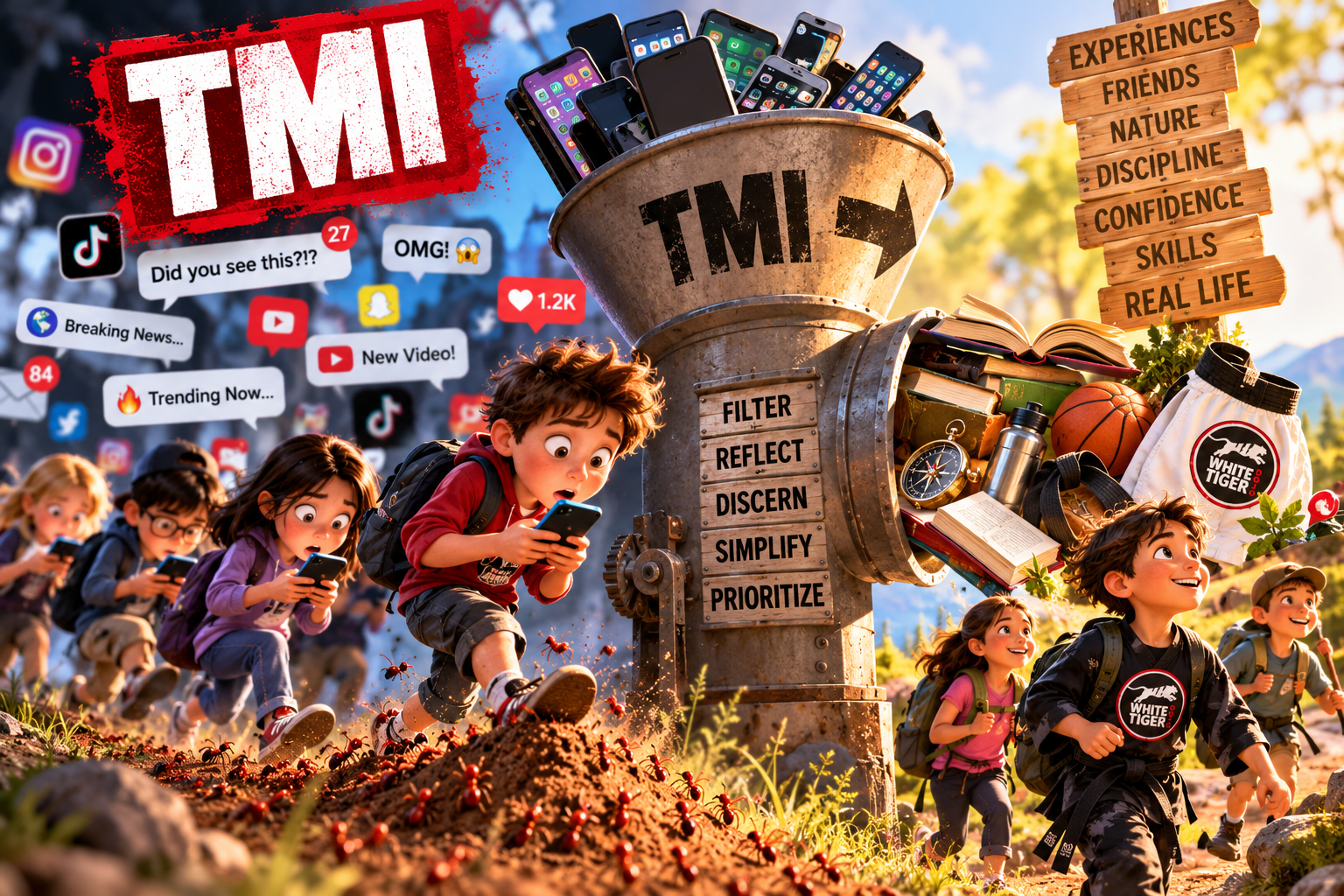
BERKELEY HEIGHTS, NJ: Too much information.
That's what a student and I once realized might be one of the bigger problems facing children, and society in general.
We've all had one of those conversations that leaves our mental space overly occupied. Or spent too much time scrolling through news, social media, videos and opinions until our brains finally imprint three little letters:
TMI.
Perhaps, as adults, we're better equipped to filter the useful from the useless, although even that costs us time and energy.
What should concern us even more is what happens when that same flood of information reaches children who may not yet have the experience necessary to understand everything they're reading, watching or hearing.
Children Have More Information Than Ever, but Information Isn't Experience
News and information now reach us instantly.
Social media.
Television.
Podcasts.
Videos.
Notifications.
One minute we're watching an adorable child doing something hilarious. The next we're reading about violence halfway around the world. Seconds later we're onto politics, weather, celebrity gossip, neighborhood alerts and whatever controversy the algorithm has decided we absolutely need to know about today.
By the time we finish processing one thing, something else has already replaced it.
That's TMI.
And if adults sometimes find filtering all of this exhausting, imagine trying to understand it as a child.
The problem isn't simply that children have access to information.
Information can be enormously useful.
The problem is that knowing about the world isn't the same thing as experiencing it.
Parents Are Dealing With Information Overload Too
This doesn't just affect children.
It affects us.
All of this information can become like unwanted pop-up ads for male enhancement or cheap, safe ways to lose weight fast.
We have social media profiles to maintain.
Emails.
Texts.
News alerts.
Neighborhood alerts.
School alerts.
Weather alerts.
And apparently alerts telling us that there are other alerts we should be alerted about.
Sometimes I have to consciously shake off the constant stream of negative information that seems to permeate everything I read, see and hear.
It's like ACME-strength chewing gum stuck to the bottom of my shoe.
And when adults are anxious about everything we're seeing, hearing and reading, it's very easy for that anxiety to influence how much freedom we're willing to give our children.
Protecting Children From Everything Can Prevent Them From Learning
I can't count how often I've heard parents talk about neighborhood safety alerts.
There's a suspicious man driving a white...
No, blue...
Nope, word on the street is it's now a maroon paneled van.
Sorry! Sorry! Folks, no need to be alarmed, that's just the undercover child-predator team keeping your children safe.
The joke is ridiculous.
But the anxiety behind it isn't.
Parents understandably want their children to be safe.
The difficulty is remembering that keeping children safe and preventing children from experiencing anything uncomfortable are not the same thing.
At some point children have to learn how to move through the world without us standing three feet behind them.
They have to make decisions.
Solve problems.
Get things wrong.
Recover.
And gradually become more capable of caring for themselves.
Otherwise, why would they ever leave the confines of their parents' houses?
But nobody wants to risk being that parent.
You know, the one who didn't bubble-wrap their kid and then a meteorite fell on him.
Children Need Opportunities to Become Independent
Sometimes we're so busy making sure we're not doing the wrong thing for our children that it's easy to forget part of raising them is gradually teaching them how to function without us.
And yet, eventually, off they go into the wild green pastures of college to sow their seeds of intelligence and rub elbows with the billionaire barons and baronesses of the future.
Let's take a few phone calls from the future:
“Mom, how do I make my bed?”
“I have to wash my bed sheets??”
“Wait, how do you wash things?”
Of course, I saw some of this when I was in college myself, long before the social media craze.
They were amusing problems then.
The difference today is that a child can have nearly unlimited access to instructions, explanations and answers without necessarily having unlimited opportunities to do things for themselves.
Google can tell you how to wash your sheets.
YouTube can show you.
Neither one can wash them for you.
At some point, knowledge has to become competence.
Children Need to Experience Failure Without Us Fixing Everything
This is where I think the problem becomes bigger than technology.
With all of this information gathering, sorting and filtering, when do children have time to:
Fail on their own?
Discover on their own?
Lose on their own?
Solve something on their own?
Pick themselves up and succeed on their own?
That doesn't mean abandoning them.
It means giving them developmentally appropriate opportunities to experience the consequences of decisions while the stakes are still relatively small.
If we solve every problem before our children encounter it, they lose an opportunity to practice solving problems.
If we answer every question before they struggle with it, they lose an opportunity to think.
If we remove every frustration, they lose an opportunity to discover that frustration can be survived.
That's an important lesson.
More Information Doesn't Automatically Create Better Judgment
Having access to information is incredibly useful.
But information and judgment aren't the same thing.
A child can know a tremendous amount and still have very little experience applying that knowledge.
That's where parents, teachers and mentors come in.
Our job isn't simply to give children answers.
Part of our job is teaching them how to decide:
Is this information useful?
Is it accurate?
Does it apply to me?
What should I do with it?
Do I need an adult's help?
Can I solve this myself?
That's a very different skill from simply knowing how to search for an answer.
And as children become surrounded by more information, the ability to filter information may become more important, not less.
Good Parenting Isn't About Eliminating Every Risk
When I originally wrote about this subject, I pointed to declining violent-crime numbers because I thought there was an interesting disconnect between how dangerous people sometimes felt the world had become and what the crime numbers actually showed.
But the larger point doesn't depend upon one year's crime statistics.
Fear and risk are not always the same thing.
The fact that we hear about something constantly doesn't necessarily tell us how likely it is to happen to us.
And the fact that something carries some risk doesn't necessarily mean children should never experience it.
Learning to navigate the world requires judgment.
That judgment develops gradually.
We establish boundaries.
We explain why they exist.
We give children some room within those boundaries.
We watch what happens.
And as their judgment improves, we gradually give them more responsibility for protecting themselves.
Teach Children How to Filter the World, Not Hide From It
The digital age undoubtedly has benefits.
Children have access to knowledge and opportunities that would have seemed unimaginable when many of us were their age.
The answer isn't to hide from technology.
It isn't to hide from information either.
It's to teach children how to use both.
Current guidance for families increasingly reflects that idea. Healthy digital habits aren't only about counting minutes in front of a screen. They involve considering what children are doing with media, what that media may be displacing, establishing family boundaries, and helping children develop critical thinking about what they encounter online.
And perhaps we adults need to practice some of that ourselves.
Turn off an alert.
Put down the phone.
Stop consuming information simply because someone has made it available to us.
Let the kids solve something before we solve it for them.
Let them explore within reasonable boundaries.
Let them make some mistakes while we're still close enough to help when they genuinely need us.
Because the point of raising children isn't to protect them from ever experiencing the world.
It's to prepare them to eventually navigate that world without us.