
Too Polite
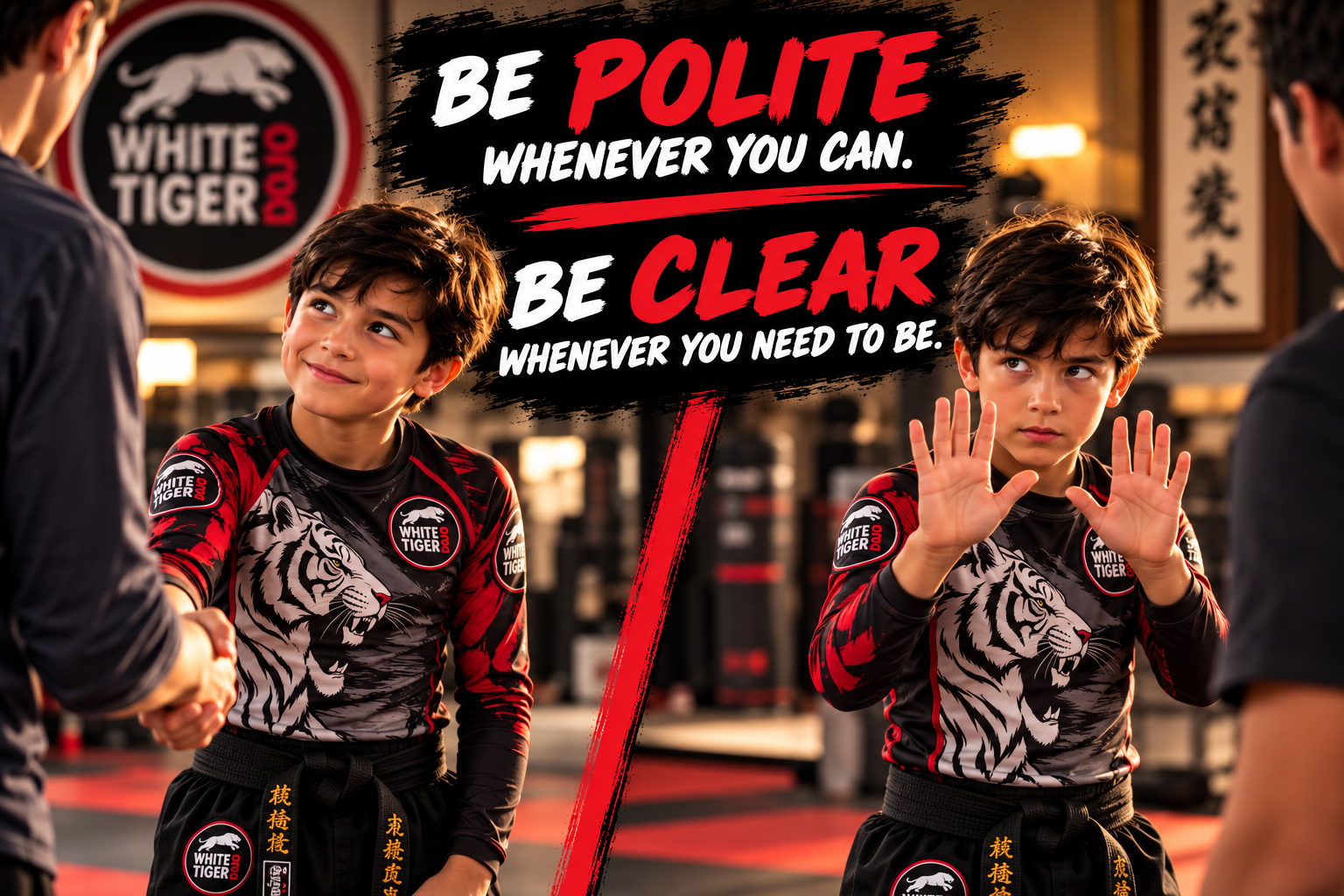
Being polite doesn't mean surrendering personal boundaries. The 3 Ps of distance can help children understand personal space, communicate clearly and become more assertive when something feels wrong.
BERKELEY HEIGHTS, NJ: We live in a society where politeness is not only taught, but encouraged.
That's generally a good thing.
But like almost anything, too much of a good thing can create an imbalance.
Being polite doesn't mean allowing someone unfettered access to our space, time or attention.
When I think about my surroundings, I think about how much control I have over the space around me.
Controlling that space requires awareness of what I call the 3 Ps of distance: Perimeter, Proximity and Personal.
Being Polite Doesn't Mean Giving Up Your Boundaries
We spend a lot of time teaching children to be polite.
Say please.
Say thank you.
Don't interrupt.
Be respectful.
Be nice.
Again, those are good lessons.
But children also need to understand that politeness and compliance are not the same thing.
There are circumstances when a child should speak clearly.
Say no.
Move away.
Ask someone to stop.
Find an adult.
Leave.
Or make enough noise to draw attention to what's happening.
Good manners should help children interact with other people. They shouldn't prevent children from establishing a boundary when they need one.
That's where the 3 Ps become useful.
Perimeter: Pay Attention to the People and Environment Around You
Perimeter is the outermost layer.
It includes physical boundaries such as walls, streets, doors and obstacles.
It also includes people within the larger environment around us:
Strangers on the street.
People in an office building.
Students on a campus.
People in a store.
People moving through our community.
Most of these people deserve ordinary courtesy.
They don't deserve automatic suspicion.
But courtesy doesn't require us to assume that everyone we encounter has good intentions either.
Awareness isn't the same thing as fear.
If someone begins closing the distance between themselves and us in a way that makes us uncomfortable, we have every right to create more space or clearly ask them to stop.
That's not impolite.
That's establishing a boundary.
Proximity: Familiarity Doesn't Automatically Mean Trust
Proximity includes spaces and people that are more familiar to us.
Your neighborhood.
Your block.
Your office.
Your child's school.
The dojo.
People you recognize because you encounter them regularly.
Familiarity naturally changes the way we interact.
We may extend more trust to someone we've seen a hundred times than someone we've never met.
But familiarity doesn't eliminate boundaries.
Someone knowing your name doesn't give them unlimited access to your time.
Someone being your neighbor doesn't give them unlimited access to your property.
Someone attending the same school doesn't give them unlimited access to your child.
And someone being familiar doesn't mean they get to decide where your boundaries should be.
Proximity is not the same thing as personal.
When someone misunderstands that distinction, we may have to make the boundary clearer.
Personal: You Are Still the Arbiter of Your Personal Space
Personal space is reserved for the people and places where we allow greater intimacy.
Our homes.
Close friends.
Family members.
Significant others.
Trusted colleagues.
The people we hug.
The people we confide in.
The people we've deliberately allowed closer.
But even here, boundaries still exist.
Trust doesn't eliminate the right to say no.
Affection doesn't eliminate it.
Family doesn't eliminate it.
Friendship doesn't eliminate it.
And a boundary that was acceptable yesterday doesn't automatically have to remain acceptable today.
We are still the ultimate arbiters of our personal space.
When someone crosses that boundary, we have the right to communicate our discomfort clearly.
Assertiveness Is Not the Same Thing as Rudeness
This distinction is particularly important for children.
Many children hesitate to establish boundaries because they don't want to appear rude.
But there's a tremendous amount of space between being polite and being aggressive.
That's where assertiveness lives.
"Please stop."
"I don't like that."
"Back up."
"Don't touch me."
"I said no."
"I need some space."
Those statements aren't inherently rude.
They're clear.
And when a softer request isn't respected, the communication may need to become louder, firmer and more direct.
The purpose isn't to win an argument. The purpose is to make the boundary unmistakable.
Personal Safety Begins Before Physical Self-Defense
People sometimes think self-defense begins when someone throws a punch.
I think it begins much earlier.
It begins with awareness.
Distance.
Communication.
Judgment.
Boundaries.
Knowing who is around you.
Recognizing when someone is getting too close.
Understanding when familiarity deserves trust and when it doesn't.
Being willing to say something when something doesn't feel right.
These skills can help us prepare for problems, prevent unnecessary conflict and protect ourselves when a boundary isn't respected.
Physical self-defense is one option.
Hopefully, it's one we rarely need.
Teaching Children the 3 Ps of Personal Space
The 3 Ps give children a simple way to begin thinking about distance:
PERIMETER
Who and what is around me?
PROXIMITY
Who is getting closer, and how familiar are they to me?
PERSONAL
Who have I chosen to allow into my personal space, and what access am I comfortable giving them?
These boundaries won't always be perfectly defined.
Nor should they be.
Relationships change.
Circumstances change.
Trust changes.
Children grow.
The important thing is learning that they're allowed to notice those changes and respond to them.
Healthy Boundaries Leave More Room for Genuine Kindness
Maintaining boundaries takes discipline and effort.
But over time, clear boundaries can reduce the stress and resentment created by unwanted intrusions.
And there's an interesting consequence.
When we aren't constantly giving our time, attention and personal space to people simply because we're afraid of appearing impolite, we have more of ourselves available for the people and relationships that genuinely matter to us.
Being assertive doesn't make us less kind.
Having boundaries doesn't make us less generous.
And saying no doesn't automatically make us impolite.
Sometimes the clearest boundary is also the most respectful response we can give.
Be polite whenever you can.
Be clear whenever you need to be.
And understand the difference.