
Who Owns You? The Relationship Between Self-Control and Self-Defense
Can four walls and a sign guarantee our safety? Discover why self-control, awareness and the courage to establish boundaries are essential to self-protection.
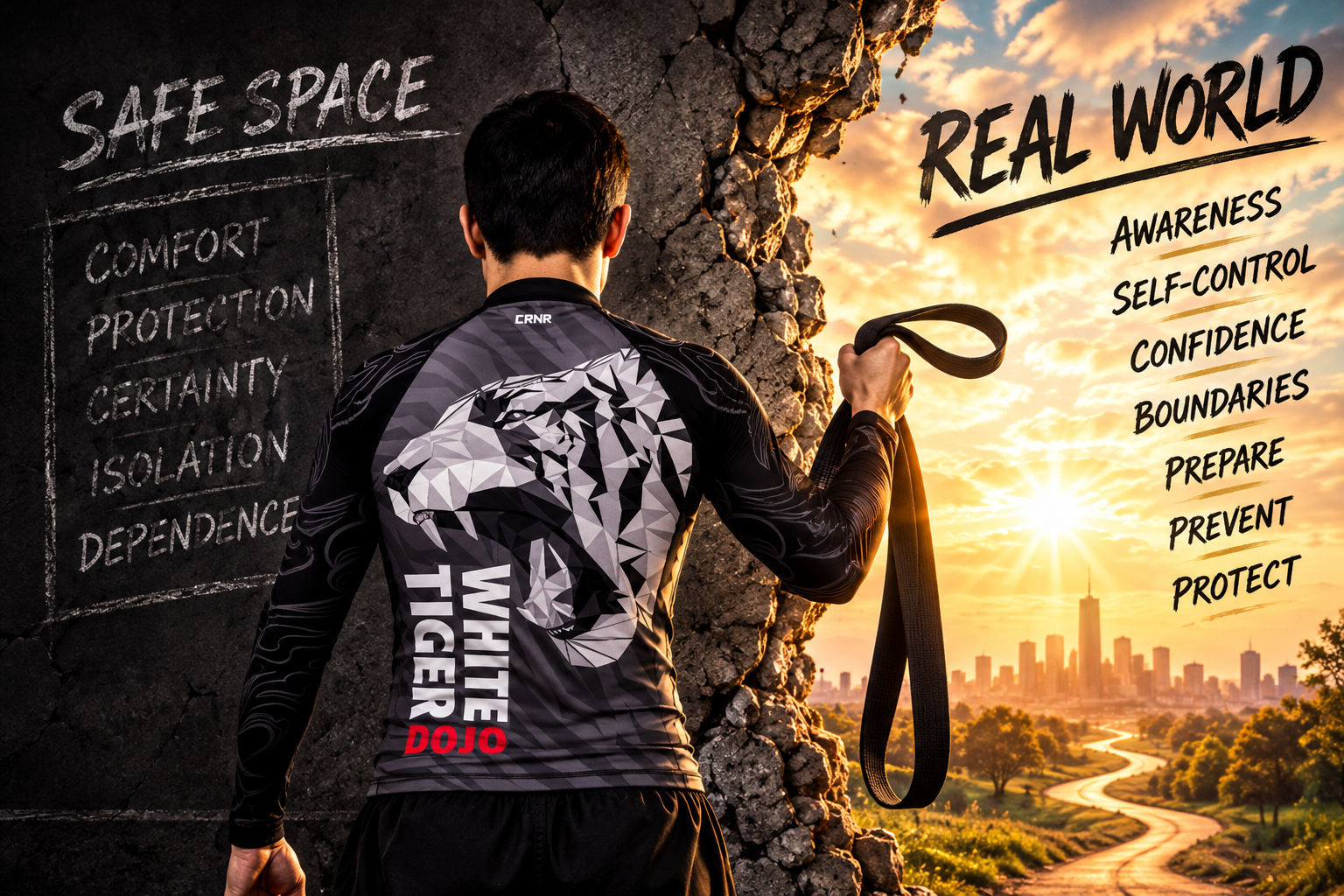
Part 2 of the Safe Space Series
BERKELEY HEIGHTS, NJ: In my last blog entry, I challenged the thinking behind a "safe space."
In short, when I rely entirely on other people or a particular environment in order to feel safe, I risk surrendering some control over my own well-being.
When I abdicate the most basic of human rights, the right of self-protection, to another person, group or environment, I no longer have complete control over my own life.
Why Self-Control Is the Foundation of Self-Defense
As a teacher, this abdication flies in the face of my most important lesson: self-control.
I tell my students, "If you cannot control yourself, then you will not be able to learn how to defend yourself."
What is self-protection if not the ability to control yourself in order to prevent someone else from controlling you?
What is a bully or a criminal other than a person trying to force another to comply with their wishes?
Of course, we cannot control everything other people do. But we can develop greater awareness, judgment and the ability to respond appropriately when our boundaries are challenged.
Self-defense begins with self-control, not physical confrontation.
Can a Safe Space Create a False Sense of Security?
If I allow society to provide me with a "safe space" emotionally, physically or mentally, am I also allowing everything outside that space to be considered "unsafe"?
Essentially, when I depend on designated safe spaces, do I begin to view everything else as chaos?
What's more, isn't it naive to believe that four walls and a plaque on the door can protect us from other human beings? Or even from ourselves?
A safe environment can certainly provide comfort, support and necessary protection. There is value in that.
But labeling an area as a "safe space" does not automatically make it free from danger. And believing that a label alone guarantees our safety can lull us into a false sense of security.
As a teacher and a human being, I don't want my students or fellow human beings falling into this mentality.
Safety should not depend exclusively on where we are. It should also involve what we have learned to recognize, prevent and manage.
Why Physical Training Matters as Much as Mental Strength
It seems that so much about today's world is about mentality.
In our modern-day society, thoughts and emotions are often treated as the reigning kings of all that is sacred and successful.
Why, then, is the body sometimes given such low-class treatment?
As Socrates is often quoted as saying:
No man has the right to be an amateur in the matter of physical training. It is a shame for a man to grow old without seeing the beauty and strength of which his body is capable.
It's important to remember that a beautiful mind is only as prepared as the body attached to it.
Our minds and bodies are not separate entities competing for importance. They are partners.
In order to navigate both "safe" and "unsafe" spaces, we should exercise our bodies and minds in the art of self-protection.
Teaching Boundaries Through Words, Deeds and Actions
This does not mean the genius must resolve his disputes with fisticuffs, nor the "fighter" reduce his exam paper to confetti.
Rather, both archetypes should develop the awareness, grit and courage to know **when and how to establish boundaries through words, deeds and actions.**
Sometimes that means speaking up.
Sometimes it means walking away.
Sometimes it means asking for help.
And sometimes it means having the physical skills necessary to protect ourselves when other options have failed.
The goal is not to eliminate every danger from our lives. Nor is it to pretend that training makes us invulnerable.
The goal is to become more capable of recognizing challenges, making decisions and taking appropriate action.
Without these abilities, we risk surrendering our independence to the tyrant of inaction.