
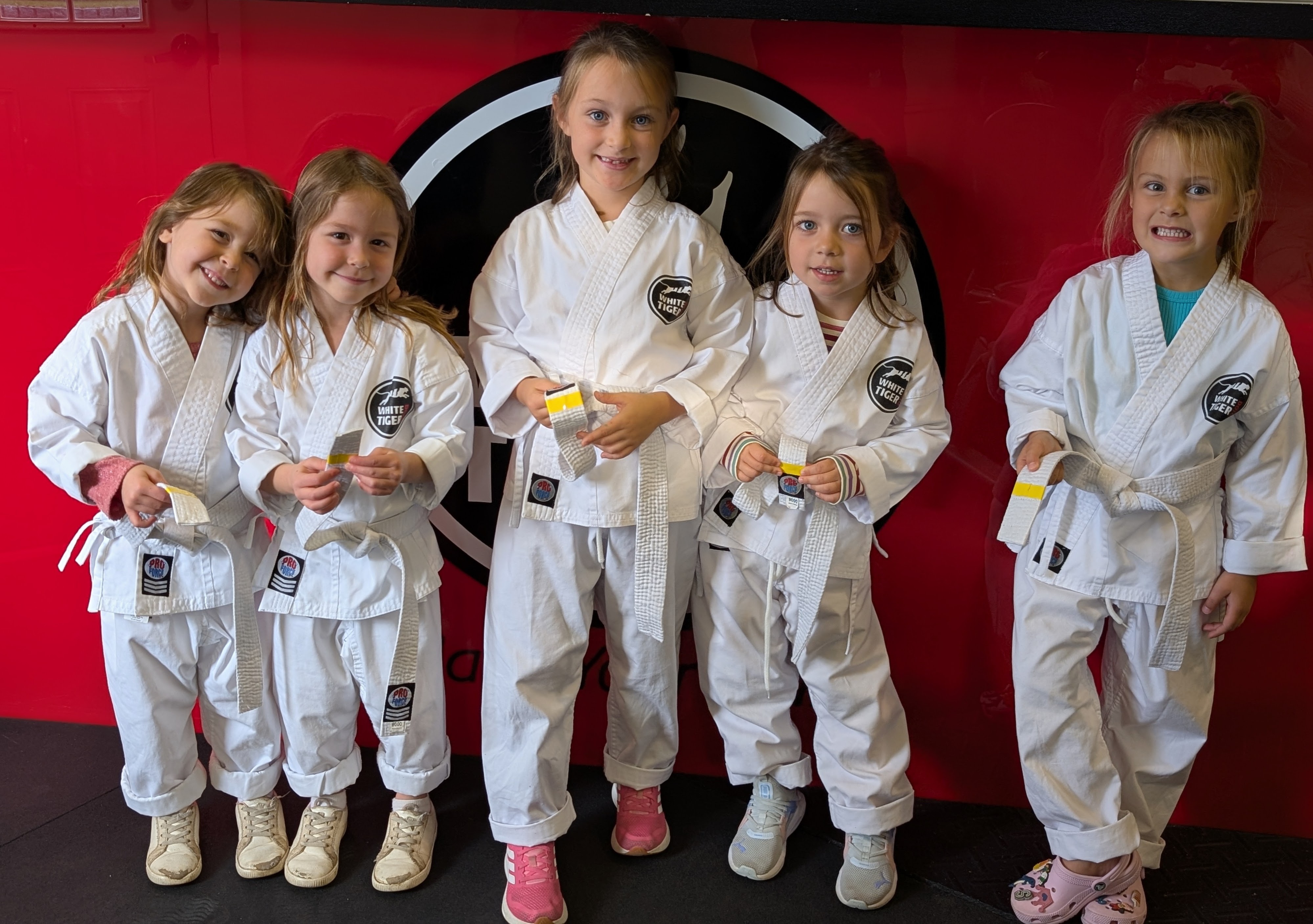
Karate for Ages 4 to 6
Short classes. Real skills. A first experience that makes them want to come back.
Why we start at four
Four is the age most children can genuinely handle a group class. They can follow a sequence, wait their turn, and hold an idea long enough to practice it. Before that, a class is mostly crowd control.
So KinderKubs is built around what a four, five, or six year old can actually do. Thirty minutes, not an hour. Clear instructions. Constant movement. Enough repetition to build a skill and enough variety that nobody checks out.
What your child learns
Some of it looks like martial arts. Stances, blocks, basic strikes and kicks, how to move and hold their balance.
Most of it is underneath that.
- Listening the first time. Instructions come once. Following them is part of the training.
- Waiting their turn without losing focus while someone else goes.
- Trying something they are not good at yet, and staying with it.
- Body awareness and coordination that shows up in every other sport they will try.
- Speaking up with a clear voice when they are asked to.
Parents usually notice the listening first, and usually at home.
What a first class looks like
You walk in, sign in, and your child joins the line. Nobody is thrown into anything. New students spend the first class learning where to stand, how to bow in, and one or two basic movements.
Sensei Darren teaches every class personally. He will learn your child's name before they leave.
You are welcome to stay and watch. Most parents do.
Wear: comfortable clothes they can move in. No uniform needed for trial classes. Bare feet on the mat.
Class times
KinderKubs runs 30 minutes:
- Tuesday, Wednesday, Thursday, Friday: 4:00–4:30 PM
- Saturday: 10:00–10:30 AM
Most families train once or twice a week. Twice tends to build momentum faster at this age, but once is a real start.
Questions parents ask
My child is shy. Is this going to be too much?
Shy kids often do well here, because the structure is predictable and nobody is singled out. Sensei Darren adjusts to how each student learns. That is not a slogan, it is the reason the classes stay small.
Is it aggressive?
No. At this age there is no sparring and all contact is controlled partner work supervised closely by Sensei Darren. The physical skills are taught slowly and safely.
What if they do not like it?
Then you have spent nothing and lost three thirty-minute blocks. That is the entire point of the free trial.
What happens after KinderKubs?
At seven, students move into the Pre-Teen program and continue the same belt curriculum. Many of our current brown and black belts started as KinderKubs.
Try three classes. No cost, no commitment.
Pick a day and time that works for your week. We will confirm by text and send everything you need before the first class.
No contracts to try. No hard sell, ever.